Tuesday, February 07, 2012

Reconstruction as an Insurgency


Cross posted from Blog Them Out of the Stone Age

Mike Few, the editor of Small Wars Journal, recently interviewed me about Reconstruction as an insurgency. Here's his first question and my response:

Mike Few: Traditionally, social scientists, viewing conflict through the lens of the state, prefer to quantify wars as resulting in a win, loss, or tie; however, history shows that the construction, reconstruction, or deconstruction of the state following a conflict is often a long process with mixed results. Why did the Civil War not end after Confederate Gen. Joseph E. Johnston surrendered to Union Gen. William T. Sherman at Bennett Place, Durham, NC and General Robert E. Lee surrendered the Confederate Army of Northern Virginia to Lieutenant General Ulysses S. Grant, at the home of Wilmer and Virginia McLean in the rural town of Appomattox Court House, Virginia?

Mark Grimsley: It’s important to acknowledge that in an important sense, the war did end in 1865, because the federal government’s two goals—the restoration of the Union and the destruction of slavery—had both been achieved. White southerners gave up the idea of an independent Confederacy, and they showed every sign of accepting the lenient terms for return to the Union offered by the administration of Andrew Johnson. The Republican-controlled Congress, however, believed that more stringent terms were necessary to achieve the fruits of victory. In the words of Richard Henry Dana, a prominent Republican, they insisted on holding the former Confederate states in “the grasp of war” until the political dominance of the Southern elite was eliminated. A key component of their plan to accomplish this involved the imposition of universal male suffrage for African Americans. Essentially, the Reconstruction insurgency was a successful effort to break the grasp of war and restore what Southern conservatives termed “Home Rule.”

A more clunky response, since you mention social scientists, would be to point to the Correlates of War Study, which defines a war as any event that results in a thousand or more battlefield deaths each year. If you substitute “deaths from political violence” for “battlefield deaths,” then several years during Reconstruction would come close to meeting this standard. In Louisiana alone, for example, an estimated 2,500 people perished between 1865 and 1876.

Full interview

Friday, January 06, 2012

Outflanking the Bad Guys

The Civil Warriors Wordpress site has been plagued with malicious script, and what with the demands of work and life I haven't yet found time to address the issue decisively.

Luckily, I discovered that I could create a redirect to its former home, namely the blog on which you've just landed.

So Ethan and I are back in action.

Huzzah!

Sunday, September 10, 2006

Experiencing Technical Dificulties

The server for the Wordpress edition of Civil Warriors is down. It should be back shortly. If not, we'll publish on this site until it is.

Monday, May 23, 2005

I created this site as an experiment and have discontinued it, choosing instead to consolidate all my history-related blogging on a single site, Blog Them Out of the Stone Age. You'll find Civil War-related entries there.

Monday, March 28, 2005

History of Confederate Troop Strength

Fascinating graph of fluctuating Confederate troop strength over the war's four years. (Hat tip to Civil War Bookshelf.)

Sunday, March 20, 2005

Antietam Photos

A nice series of recent black and white views of Antietam National Battlefield, by photographer Darin Boville.

Saturday, March 19, 2005

Rally on the High Ground


Rally on the High Ground: The National Park Service Symposium on the Civil War, is available as an online book.

The National Park Service, the National Park Foundation, and Eastern National sponsored a symposium on May 8 and 9, 2000 at Ford's Theatre in Washington, DC. They brought together many of the leading scholars on the Civil War era with park managers, interpreters and educators to explore new research and interpretations of this period of American history. This symposium, Rally on the High Ground, became much larger and more important than the sponsors envisioned. It was broadcast nationally on C-Span, and many of the nation's leading media sources covered the event. The papers from this symposium are published here in Rally on the High Ground: The National Park Service Symposium on the Civil War. A 120-page paperback edition is available for purchase. (Just follow the link, above, to the order form.)

Saturday, February 05, 2005

Black American Contributions to Union Intelligence


Reprint of article from Studies In Intelligence, a journal published by CIA's Center for the Study of Intelligence.Posted by Hello

Wednesday, February 02, 2005

Mark Grimsley, "Race in the Civil War"

Race in the Civil War.
Reprinted with permission of North and South magazine.


Note: If you are using Explorer, and the pages of the article are too small to read:
Go to "Tools," then "Internet Options."
Hit the "Advanced" tab
Scroll down to "Multimedia"
Uncheck the box next to "Enable Automatic Image Resizing"

Monday, January 31, 2005

The Last Men to Look Upon Lincoln

. . . did so in 1901, not 1865.

Mr. Lincoln's White House

From the site introduction:

It was an "ill-kept and dirty rickety concern," according to presidential secretary John G. Nicolay. "I wonder how much longer a great nation, as ours is, will compel its ruler to live in such a small and dilapidated old shanty, and in such a shabby-genteel style." A Nicolay associate in the President's office, was less critical, describing the White House as "a very respectable building of brick and stone, painted white, built in the form of a parallelogram, two stories high fronting north; but, owing to the declivity, three stories fronting south toward the Potomac."

President Abraham Lincoln himself once called it "this damned house," and when he was besieged by office seekers and afflicted by bad news from the war front, the White House must have seemed truly damned. But, despite its drawbacks, the White House was a clear improvement on the family's previous living accommodations. Indeed, the President also declared it was "better than any house they have ever lived in." For the four years and one month of Mr. Lincoln's presidency from March 1861 to April 1865, it was home to the Lincoln family and the center of efforts to restore the Union and abolish slavery.

You're going to feel like almost like you've actually been there once you've taken this state-of-the-art virtual tour.


The Valley of the Shadow


You're in for a treat. Check out this path-breaking history project, focusing on the Civil War era experiences of Augusta County, Virginia, and Franklin County, Pennsylvania. The Valley of the Shadow won the first e-Lincoln Prize in 2001. Posted by Hello

Sunday, January 30, 2005

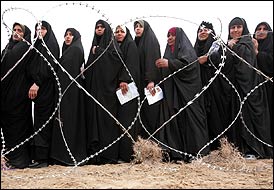
The First Vote, 2005


Posted by Hello

The First Vote, 1868


It was impossible for a historian of the Civil War and Reconstruction era to watch the election in Iraq today and not be reminded of the first vote for African Americans in the South, 1868.

Following the anti-immigrant tangent

From A.C.E.:

On Friday our Civil War reading group confronted Everard H. Smith, “Chambersburg: Anatomy of a Confederate Reprisal,” American Historical Review Vol. 96, No. 2. (Apr., 1991): 432-455. Among other things, Smith argued that Confederate anti-German sentiment contributed to the ferocity of the retaliation against the civilians of Chambersburg.

There are problems. How German was Chambersburg by 1864? No more German, perhaps, than some of the Confederate regiments that burned it. But anti-immigrant sentiment is not characterized by accurate historical assessments. Confederates recognized that Germans were among the prominent Unionists in Missouri and Texas, and that the most vocal and eloquent German-American voices in the North opposed slavery. I can accept that many Confederates were anti-German.

More interesting to me is a broader question: What did anti-immigrant sentiment mean during the Civil War? How deep did it run?

In the antebellum South it meant something to be white. It meant not being black. European immigrants such as the Germans were clearly white. The Civil War intensified the need for white solidarity to overcome distinctions in social position, wealth, and nativity. Did Everard Smith mean to adjust this widely-accepted interpretation? I think there is still room for anti-immigrant sentiment, but we need to further examine what such sentiment would mean in a war for white supremacy.

In the North, historians have shown, things were more complicated. European immigrants received citizenship rights based on their whiteness, but the Irish, and sometimes even the Germans, were considered racially different from Anglo-Saxons. There had been significant anti-immigrant riots in the 1850s, and during the war immigrants became scapegoats. The German divisions of the Eleventh Corps of the Army of the Potomac were singled out for blame in the Union defeat at Chancellorsville in Spring, 1863. Germans were disloyal cowards. One major general, who was mentioned by name in critical newspaper reports, spent the rest of his life trying to clear the reputation of his troops. But Carl Schurz also became a U.S. Senator and the Secretary of the Interior under President Hayes. Rather than suffering from the accusations, he used them to consolidate his immigrant support. Attacks on him as a German did not hurt him politically.

Anti-immigrant sentiment existed on both sides during the war. But I still don’t think we know what it really meant.


Ed. Note: Readers with access to JSTOR will find the article online.

Restraint and Reprisal


From Mark G.:

This Friday the Civil Warriors will meet to discuss:

Everard H. Smith, "Chambersburg: Anatomy of a Confederate Reprisal," American Historical Review Vol. 96, No. 2. (Apr., 1991), pp. 432-455.
(You'll need access to J-STOR to read the article. )

The article gets at the issue of when and why restraint breaks down in war. In 1995 I gave a lecture at the U.S. Military Academy that also addressed this question--and also discussed what is needed for restraint to hold up:

Union Soldiers and the Persistence of Restraint in War

War Comes Home: Chambersburg, Summer of 1864
provides a good, brief introduction to the burning of the town, and links to an excellent archive of illustrations.

The US Civil War Center (USCWC): An Appreciation

The U.S. Civil War Center (USCWC) was founded in 1993 and is involved with a number of projects, but the best-known is its attempt to link to every scrap of information on the web that touches upon the Civil War era. To date it has found and cataloged about 9000 sites, though inevitably at any given time, some of the links are "broken;" that is, they lead only to a 404 error code.

The main point of entry is Index of Civil War Information on the Internet.

From an introductory page that explains the center's mission, history, etc.:

The Center has been called an "information clearinghouse." However, the Center is not a museum or a library. While we do not maintain original documents on the premises, we help direct individuals to the appropriate experts, institutions, and books for their research projects. Each day we are contacted by phone, fax, mail and e-mail by scholars, teachers, students, movie producers, reenactors, librarians, and amateur genealogists who are working on a diverse group of projects.

If you have a question, please be sure your first step is to view the Index, Questions, and Researching People of the Civil War Era sections on the Center's web site. Once you have examined our available links, we ask that you submit all inquiries in writing, either via mail, fax or e-mail.

The USCWC essentially vaccums up all the info on the web it can and parks that info as best it can in an extensive index. The center knows the info is not always accurate or reliable and that it may be part of idiossyncratic, even offensive historical interpretations. It expects users to know how to discern good sources from bad, bearing in mind that the meaning of "good" and "bad" are contextualized by the purpose of one's research. If I'm interested in popular memory of the Civil War, sources that would be "bad" for a college term paper on, say, Northern politics during the era, are "good" for my needs.

Over the years I've used the USCWC a lot and have always found it nothing less than extremely helpful. But as an expert on the Civil War era, I'm pretty well able to sift the wheat from the chaff pretty quickly. Therefore I thought a useful service might be to go through the index and identify the "best" links.

"Best," of course, is subjective. In general, I have thought of "best" in the sense of "value-added": I have looked for sites that tell you things or provide perspectives you could not just as easily find in an encyclopedia or some other reference work. "Value-added" does not always mean accurate, and some of these sites reflect perspectives on the Civil War era that are dated, racist, idiosyncratic, or downright weird. But usually "value-added" does mean interesting.

I vouch for the accuracy of nothing on these sites, nor for whether they respect applicable fair use laws, not whether they contain malicious code, or anything else. I won't even guarantee you'll agree with my selections. In fact, I'm sure you will disagree with some of them. I don't care. Get your own blog and make your own list.

But I do hope you'll enjoy the sites in the lists I've chosen.

The section below will provide links to specfic subject areas and will be updated as needed:


Reconstruction


USCWC: The Best Links on Reconstruction, 1862-1877

Have you read the explanation and disclaimer?

Compared to the abundance on other topics, fourteeb on the battle of Gettysburg alone, there's not that much on Reconstruction.

Total links: 27

Value-added links: 6 (or 5.5: you'll see what I mean)

Civil War II: 1865-1965 - idiosyncratic account and interpretation from the Grazian Archive. Check out the welcome page and think carefully about the nature of this source and the needs of your research. If you have some knowledge of Reconstruction (actually the whole sweep of race relations between Appomattox and the Voting Rights Act of 1965), this might be fun--and perhaps even a useful challenge to your thinking. If you have little prior background, best to avoid. You have been warned.

Civil War Reconstruction and Recovery in Brazoria County, TX Rock on! Funded in part by a grant from Humanities Texas (formerly the Texas Council for the Humanities), this is graphics rich, vivid, and thought-provoking. Note to high school students and undergrads: Brazoria County, TX, is not the South as a whole. This is a close-up of this period as it took place in one small area. The text of this exhibit was written by Dr. Betsy Powers and relies heavily on her doctoral dissertation, From Cotton Fields to Oil Fields: Economic Development in a New South Community, 1860-1920 (University of Houston: 1994.)

"Reconstructing America: Consolidation of State Power 1865-1890" by Thomas J. DiLorenzo. DiLorenzo, a professor economics at Loyola College in Maryland, is a controversial historian and this essay (in pdf) offers a controversial interpretation of the period. All historical interpretations reflect to one degree or another the worldview of the interpreter. DiLorenzo identifies explicitly with the worldview exemplified in Rockwell.com. If you want to be challenged and/or provoked, check it out.

Reconstruction!!! - a chapter from Confederate Military History supplied by Shotgun's Home of the American Civil War page. For most purposes it's badly out of date and tedious to read. And as Shotgun notes: "WARNING! This is not what you were taught in school. It has a definite Southern bias. It is not politically correct! Nor should it be. It was written shortly after the war by Southerners about Southerners."

Reconstruction and Its Aftermath, 1865-1877 - This page simply introduces America's Reonstruction: People and Politics After the Civil War, which is where you may as well begin. This online exhibit is based on a traveling exhibition, originally sponsored by the Valentine Museum in Richmond. It opened in 1996 at the Virginia Historical Society and was subsequently shown at the South Carolina State Museum, Schomburg Center for Research in Black Culture, Museum of Florida History, Museum of the New South, and the Chicago Historical Society, where its tour ended in 1999. The development of this online exhibit was sponsored by the Gilder Lehrman Institute of American History.

Thin Gray Line: Confederate Veterans in the New South - Doesn't really fit in the Reconstruction section, but this is a good, "popular history" article from the Veterans of Foreign Wars.